When Is Christmas and How Many Days Is It Celebrated?
Introduction: When Is Christmas and How Many Days Does It Last?
As December arrives, Christmas slowly becomes part of everyday life. Lights appear on streets, shops change their displays, and conversations begin to revolve around plans, travel, and time off. Even before the actual day arrives, the season already feels underway.
Although calendars clearly mark December 25 as Christmas Day, most people experience far more than a single moment. Celebrations often begin weeks earlier and continue long after the day itself has passed. This gap between what the calendar shows and what people feel is where confusion usually starts.
The Difference Between a Calendar Day and a Celebration
On paper, Christmas occupies just one date. In real life, people celebrate through preparation, tradition, and shared time. Families decorate homes, plan meals, attend events, and reconnect with relatives before December 25 even arrives. These activities create momentum that doesn’t simply stop when the day ends.
After Christmas Day, many households continue visiting family, enjoying festive meals, and keeping decorations up. Music, food, and familiar rituals extend the atmosphere naturally into the days that follow. Because of this, Christmas often blends into the end of the year instead of ending abruptly.
How Religion, Culture, and Daily Life Shape the Experience
Religious traditions influence how long Christmas holds meaning, especially within Christian communities. Churches observe specific periods connected to the birth of Jesus, and these observances continue beyond the main holiday. Even people who don’t actively follow religious practices often feel the effect through local customs and public events.
Culture also plays a strong role. Some countries place greater importance on Christmas Eve, while others focus on gatherings after December 25. School breaks and workplace holidays add another layer, stretching the sense of celebration through extended time off.
 Why the Question Keeps Coming Up
Christmas sits at the intersection of tradition, belief, and modern life. One fixed date exists, yet the celebration unfolds differently for everyone. This contrast explains why the holiday feels simple at first but becomes more complex the closer you look.
Once that difference is clear, Christmas makes much more sense — not just as a day, but as an experience shaped by how people choose to celebrate it.
Christmas Day: Date, Meaning, and Duration
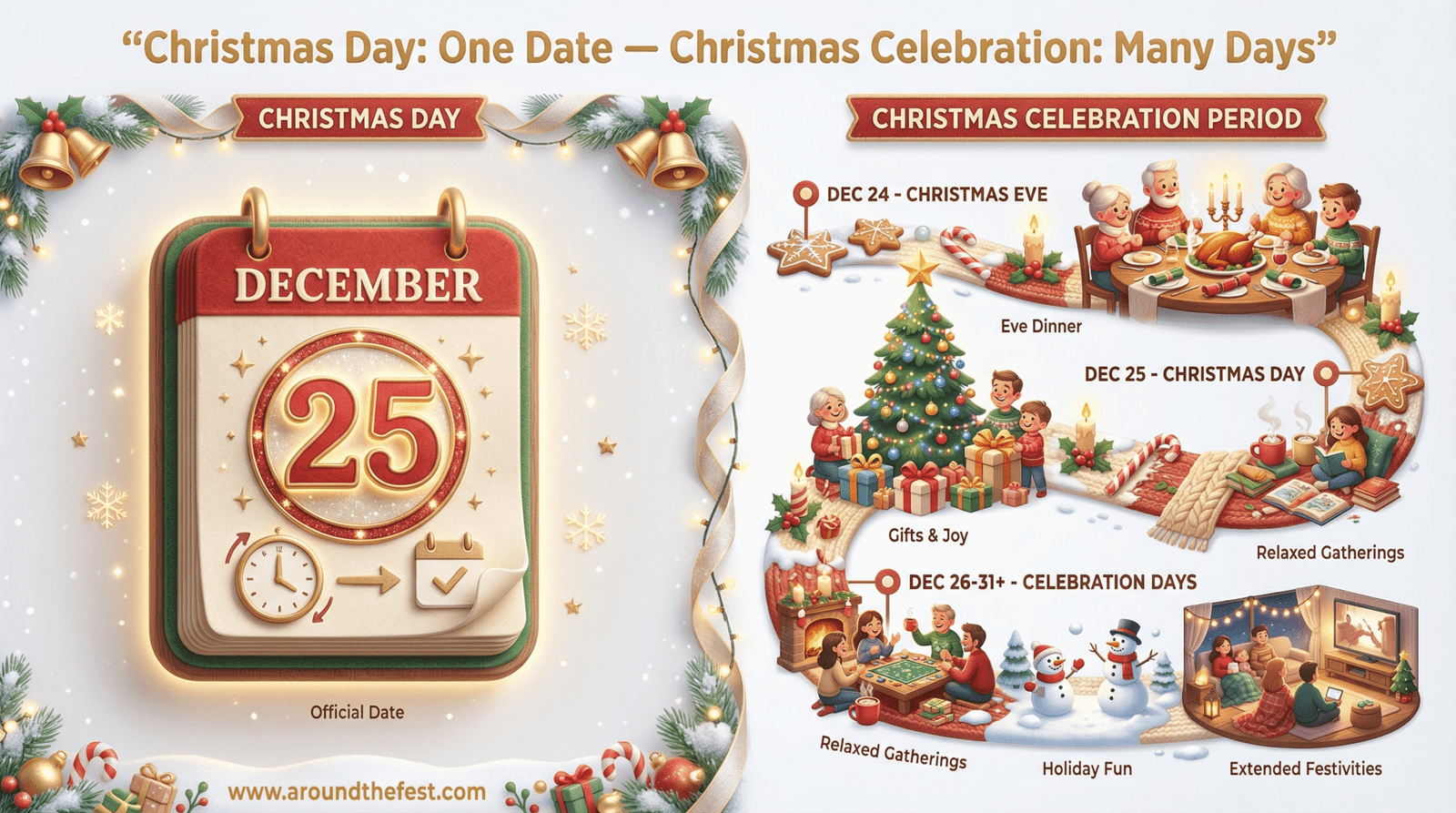
The Fixed Date of Christmas
Christmas is celebrated every year on December 25. This date does not change, regardless of the day of the week or the year. For centuries, December 25 has remained the recognized date associated with the birth of Jesus Christ, and it continues to hold that place today.
Because the date stays the same, people around the world plan holidays, travel, school calendars, and work schedules around it. Governments list it as a public holiday, and most official calendars treat it as a single, clearly defined event.
Is Christmas Officially One Day?
From an official standpoint, Christmas Day lasts one day only. It begins at midnight on December 25 and ends at midnight the same night. Schools, offices, banks, and public services usually close for this one day, especially in countries where Christmas is a national holiday.
This legal and calendar-based definition explains why Christmas appears as a single entry on planners and public holiday lists.
Why Christmas Day Feels Longer Than 24 Hours
Even though the official holiday lasts one day, most people experience Christmas over a longer period. Celebrations often begin on Christmas Eve, with family dinners, church services, and midnight traditions. These moments set the emotional tone before the day even arrives.
After December 25, many families continue celebrating through relaxed gatherings, shared meals, and visits with relatives. Because of this, Christmas Day often feels like the center point of a much wider celebration rather than a standalone event.
Understanding the Difference Clearly
To avoid confusion, it helps to separate the two ideas:
- Christmas Day is a single, fixed date on the calendar
- Christmas celebrations naturally extend beyond that date through tradition and custom
Once this difference is clear, it becomes easier to understand why Christmas feels bigger than one day while still remaining officially tied to December 25.
How Long Does the Christmas Season Last?
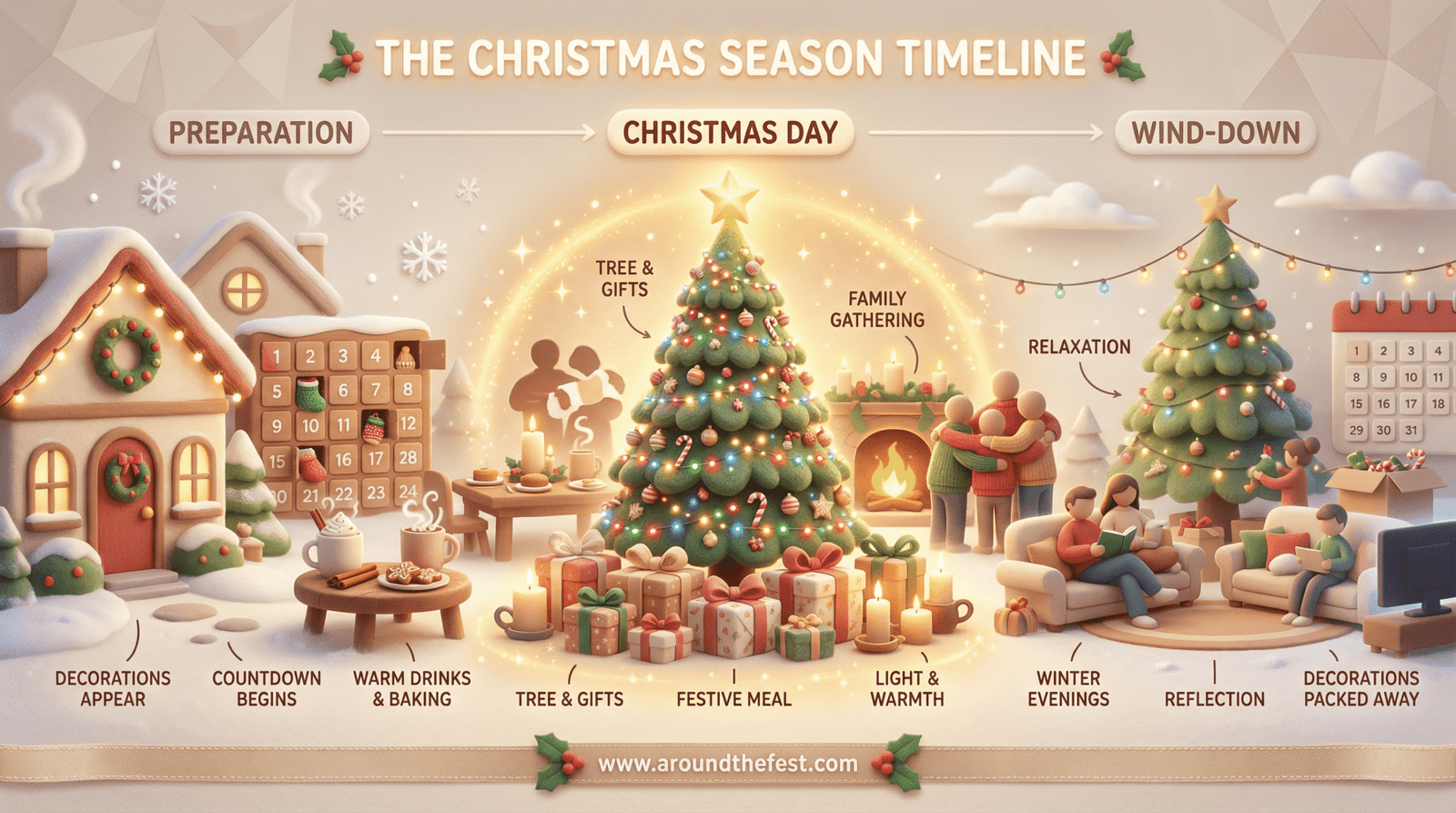
Why Christmas Is Often Experienced as a Season
For most people, Christmas does not feel like a single-day event. Instead, it unfolds gradually, shaped by anticipation, traditions, and time spent with others. While December 25 stands at the heart of the celebration, the season surrounding it often feels much longer.
This happens because Christmas blends emotional, cultural, and social experiences. Preparations begin early, routines shift, and everyday life takes on a festive rhythm. By the time Christmas Day arrives, the season already feels well underway.
When the Christmas Season Usually Begins
The start of the Christmas season varies widely depending on culture, lifestyle, and personal habits. In many households, festive preparations begin in early December. Homes are decorated, seasonal foods return, and calendars fill with gatherings and events.
In some cultures, the season begins after specific milestones, such as school holidays, major public celebrations, or religious observances. These moments signal a transition from ordinary routines to a more festive pace, even before Christmas Day appears on the calendar.
What Happens After December 25
Christmas does not suddenly end once December 25 has passed. In many families, celebrations continue through relaxed visits, shared meals, and extended time off from work or school. Decorations often remain in place, and the slower rhythm of the season carries through the final days of the year.
This post-Christmas period allows people to enjoy the holiday without the pressure of preparation. Instead of building toward an event, the focus shifts to rest, connection, and reflection. Because of this, the season often feels just as meaningful after Christmas Day as it does before it.
How Long the Season Lasts in Practice
In practical terms, many people experience the Christmas season as lasting several weeks, often from early December through early January. For some, it fades shortly after New Year’s Day. For others, it continues until religious or cultural markers signal a clear conclusion.
There is no single global timeline. The length of the season depends on:
- Cultural traditions
- Family customs
- Work and school schedules
- Personal beliefs and priorities
These factors combine to shape how long Christmas feels present in daily life.
Why the Christmas Season Has No Fixed End Date
Unlike official holidays, the Christmas season does not end on a specific calendar date for everyone. Instead, it gradually winds down as routines return, decorations come down, and attention shifts to the new year.
This flexible ending allows Christmas to adapt to modern life while preserving its emotional impact. Rather than stopping abruptly, the season fades naturally, which mirrors how people experience meaningful celebrations.
A Season Defined by Experience Rather Than the Calendar
Ultimately, the length of the Christmas season depends less on dates and more on lived experience. It exists in preparation, shared moments, rest, and reflection. Christmas lasts as long as those elements remain part of everyday life.
That is why, for many people, Christmas feels like a season — one that begins quietly, peaks joyfully, and ends gently over time.
The Meaning and Timeline of the 12 Days of Christmas
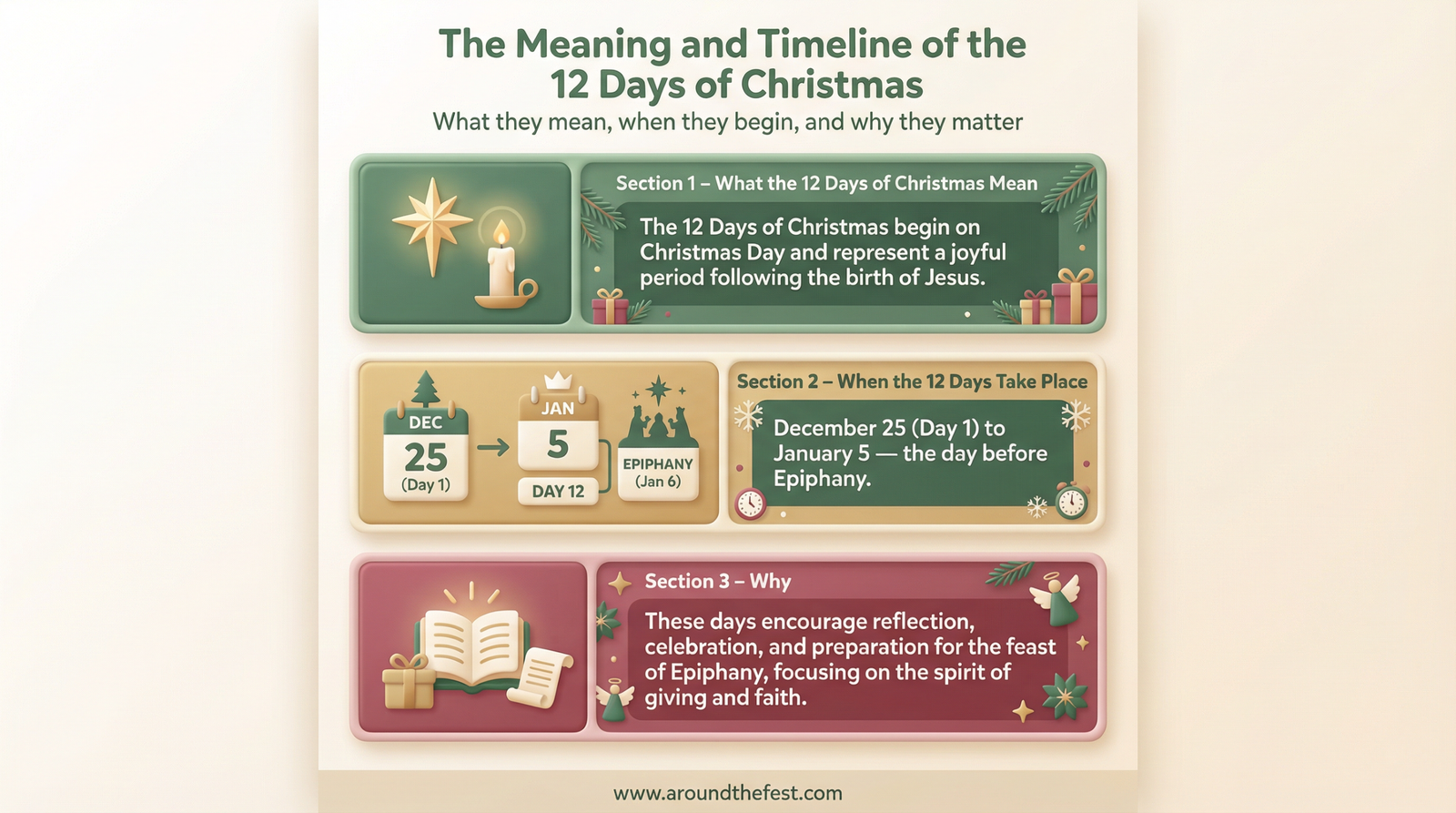
What the 12 Days of Christmas Really Mean
The phrase “12 Days of Christmas” is widely known, often because of the famous song, but its actual meaning is frequently misunderstood. Many people assume these days lead up to Christmas, when in fact, they begin on Christmas Day itself.
In Christian tradition, the 12 Days of Christmas represent a specific period of celebration that follows the birth of Jesus. Rather than marking preparation, these days focus on joy, reflection, and the unfolding meaning of the Nativity.
When the 12 Days of Christmas Take Place
The 12 Days of Christmas run from:
- December 25 (Christmas Day)
- January 5, the day before Epiphany
Each day forms part of a continuous celebration rather than a series of separate events. This timeline explains why Christmas decorations, music, and church services often continue well into early January.
Why These Days Matter in Christian Tradition
In Christian belief, the days following Jesus’ birth hold deep symbolic meaning. They reflect the time between the Nativity and the visit of the Magi, who traveled to honor the newborn child.
During this period:
- Churches continue using Christmas readings and hymns
- Nativity scenes remain on display
- The tone stays celebratory rather than reflective
Rather than ending Christmas on December 25, this tradition allows the significance of the event to be explored gradually.
How the 12 Days Are Observed in Practice
Observance of the 12 Days varies by region and denomination. Some Christian communities mark each day with prayers or special services. Others maintain a general festive atmosphere without specific daily rituals.
In many cultures:
- Decorations stay up until early January
- Family gatherings continue after Christmas Day
- Gift-giving may extend beyond December 25
These customs help explain why Christmas feels ongoing even after the main holiday has passed.
Epiphany: The Traditional Conclusion
The 12 Days traditionally conclude with Epiphany, celebrated on January 6. Epiphany commemorates the revelation of Jesus to the wider world, symbolized by the arrival of the Wise Men.
For many Christian traditions, Epiphany marks:
- The formal end of the Christmas season
- A shift in religious focus
- The transition into the next liturgical period
In some cultures, Epiphany remains a major celebration, sometimes even surpassing Christmas Day in importance.
Why the 12 Days Still Matter Today
Even in modern life, the 12 Days of Christmas continue to shape how people experience the holiday. They offer space for rest, connection, and reflection after the intensity of Christmas Day itself.
Rather than rushing back to routine, these days encourage a slower ending to the season — one that honors tradition while fitting naturally into contemporary life.
How Christmas Is Celebrated Around the World
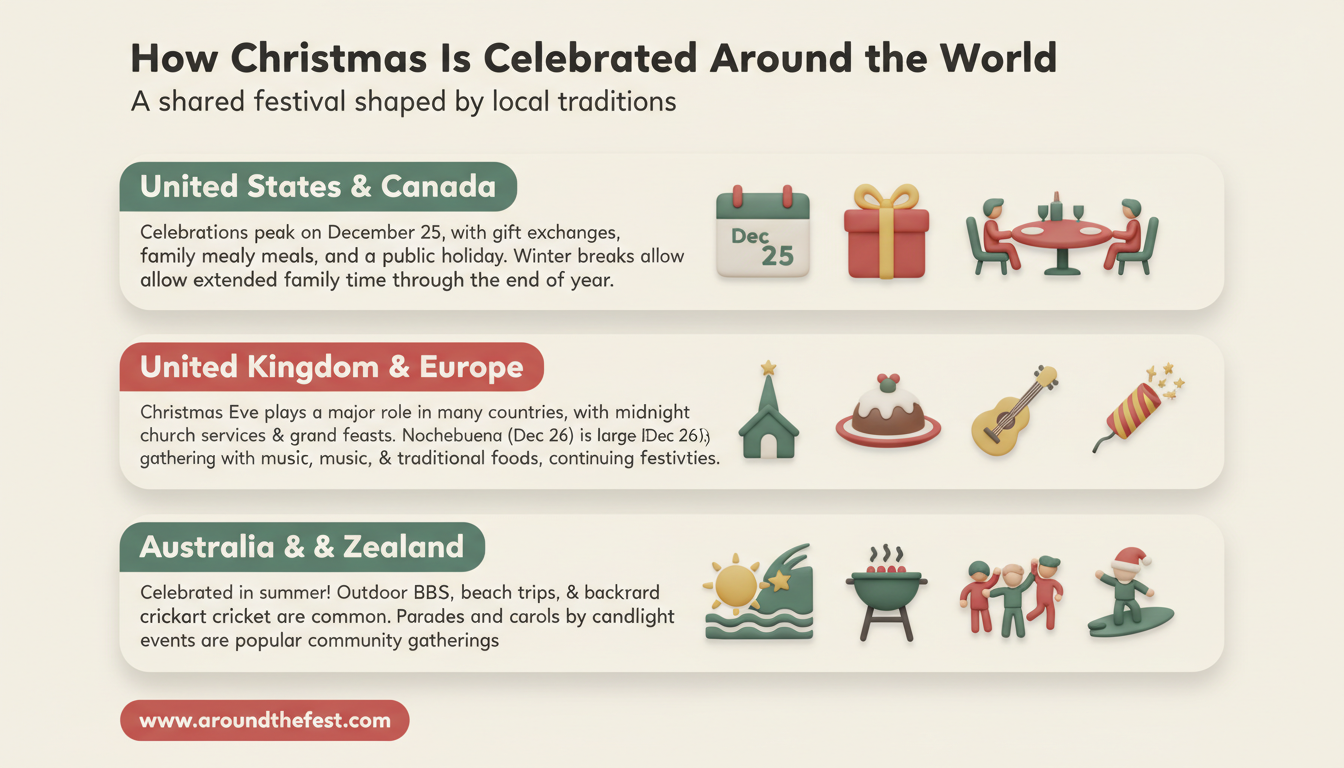
A Shared Festival Shaped by Local Traditions
It is celebrated across continents, but it rarely looks the same in every place. Geography, culture, history, and religious influence all shape how communities mark the season. While the customs may differ, the heart of the celebration remains familiar everywhere: time spent together, meaningful traditions, and a pause from everyday routines.
Rather than following one universal pattern, each country expresses it in a way that fits its own way of life.
United States and Canada
In the United States and Canada, celebrations usually reach their peak on December 25. Preparations often begin weeks earlier, with decorated homes, seasonal music, and festive events becoming part of daily life. Schools typically close for winter break, allowing families to travel and gather.
- Common traditions include:
- Exchanging gifts on morning
- Large family meals
- A public holiday on December 25
Although Christmas Day is the main event, many families continue celebrating through relaxed visits and time off until the end of the year.
United Kingdom and Europe
Across much of Europe, this Eve holds special importance. In countries such as Germany, Poland, and several Nordic nations, families come together on December 24 for a formal meal, religious services, and gift exchanges later in the evening.
In the United Kingdom:
- Christmas Day focuses on family meals and traditional foods
- Boxing Day on December 26 extends the festive break
In many European countries, celebrations continue into early January, especially in places where Epiphany plays a cultural or religious role.
Latin America
In Latin America,it often blends deep religious meaning with strong family-centered traditions. Midnight church services on Christmas Eve are common, followed by long gatherings that last into the early hours.
Across the region:
- Celebrations often stretch over several days
- Shared meals bring extended families together
- Religious customs remain closely tied to daily life
- For many households, the festive atmosphere continues well beyond December 25.
Asia and the Philippines
In many parts of Asia, it is observed both religiously and culturally, even where Christians make up a smaller part of the population. Cities and shopping districts often feature elaborate decorations, seasonal events, and public celebrations.
The Philippines is especially known for its extended season, which begins months before December and continues into January. This long celebration reflects the country’s strong Christian roots and emphasis on community and togetherness.
Australia and the Southern Hemisphere
In Australia and other Southern Hemisphere countries, it takes place during summer. Instead of winter scenes, celebrations often include outdoor meals, beach gatherings, and daytime activities.
Despite the warm weather, the focus remains the same: spending time with family, sharing food, and enjoying a break from routine.
Why the Length of Celebration Differs Worldwide
The duration of celebrations varies based on:
- Cultural traditions
- Religious practices
- School and workplace schedules
- Climate and lifestyle
These factors shape whether it feels like a single-day holiday or a longer seasonal experience.
One Celebration, Many Timelines
It shows how one shared tradition can take on many forms without losing its meaning. While the date remains the same across the world, the way people celebrate—and how long the celebration lasts—reflects the diversity of cultures that observe it.
Christmas Holidays for Schools and Workplaces
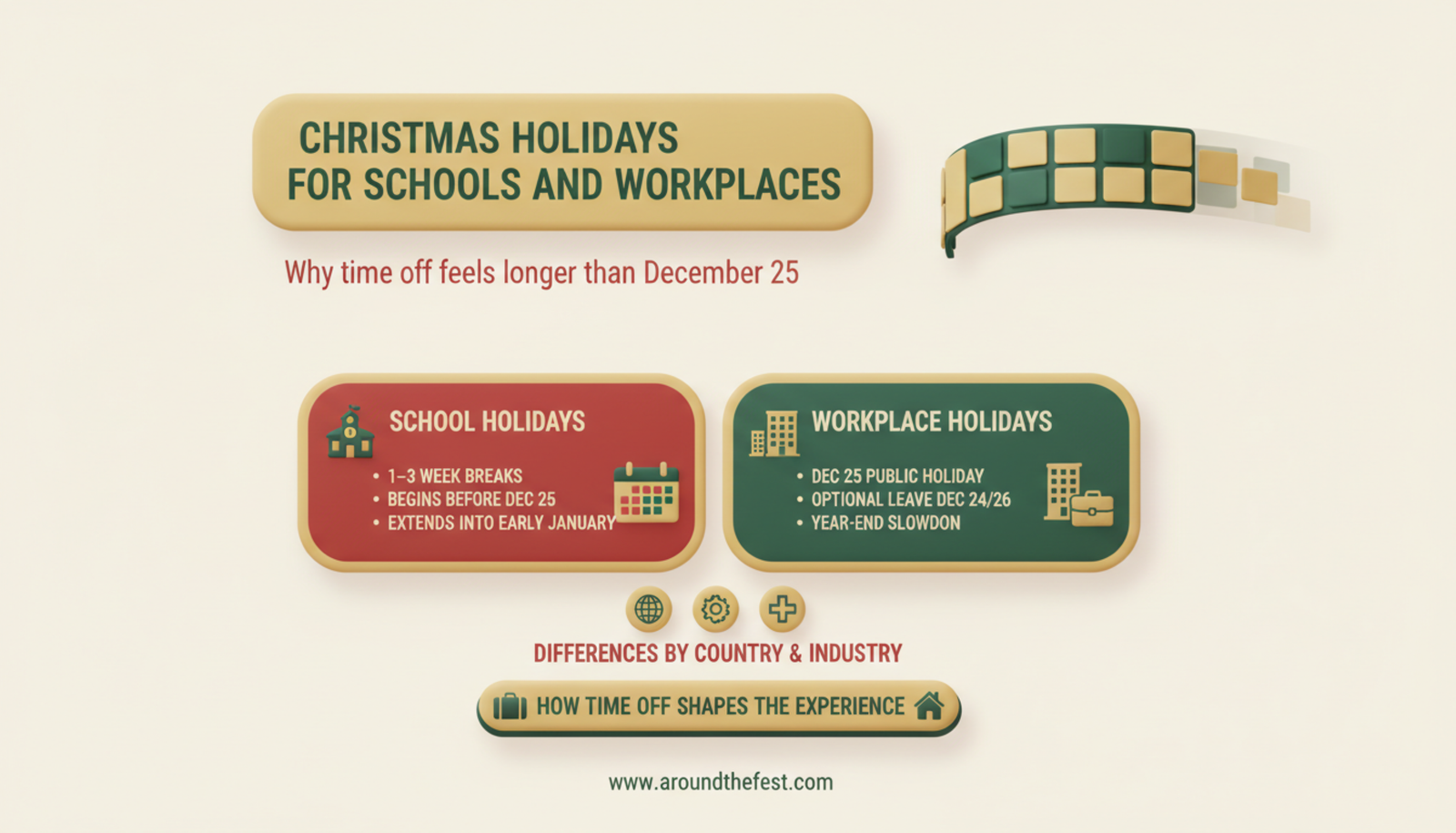
Why this Time Off Feels Longer Than the Holiday Itself
For many people, the sense that it lasts more than a day comes from school breaks and workplace holidays. Even though December 25 is the official holiday, time away from regular routines often extends well beyond that date. This gap between the holiday on the calendar and time off in real life adds to the feeling of a longer celebration.
Schools and offices follow practical schedules rather than cultural or religious traditions, which means the length of Christmas time off can vary widely.
School Holidays During Christmas
In many countries, schools close for a winter break that includes Christmas and New Year. This break often begins a few days before December 25 and continues into early January.
School breaks usually:
- Cover both Christmas and New Year
- Last one to three weeks, depending on the country
- Shape family travel and celebration plans
Because children are home for an extended period, families often spread celebrations across multiple days rather than focusing on Christmas Day alone.
Workplace Holidays and Office Closures
For most workplaces, December 25 is the main public holiday. Some employers also offer time off on this Eve, while others close for the entire period between Christmas and New Year.
Common workplace patterns include:
- One-day holiday on December 25
- Optional leave on December 24 or December 26
- Reduced work schedules at the end of the year
In industries that slow down during late December, employees may experience an informal holiday period even if offices remain technically open.
Differences Across Countries and Industries
The length of Christmas-related time off depends heavily on location and profession. Countries with strong labor protections often provide longer holiday breaks, while others limit time off to the official public holiday.
Industries such as education, manufacturing, and corporate offices often slow down significantly at the end of the year. Essential services, retail, and healthcare, on the other hand, may operate at full capacity, changing how workers experience the season.
How Time Off Shapes the Experience
Extended breaks create space for travel, family visits, and rest. When routines pause, celebrations naturally stretch out. People may celebrate before December 25, take time to relax afterward, and ease back into normal life slowly.
This rhythm explains why it often feels like a longer period, even for those who do not observe extended religious or cultural traditions.
A Practical Reason Christmas Feels Like a Season
While traditions and beliefs play an important role, school calendars and workplace schedules strongly influence how long Christmas feels in everyday life. When time off extends beyond a single day, the celebration does too.
In this way, practical arrangements help turn this from a one-day holiday into a broader seasonal experience.
Why There Is Confusion About the Length of Christmas
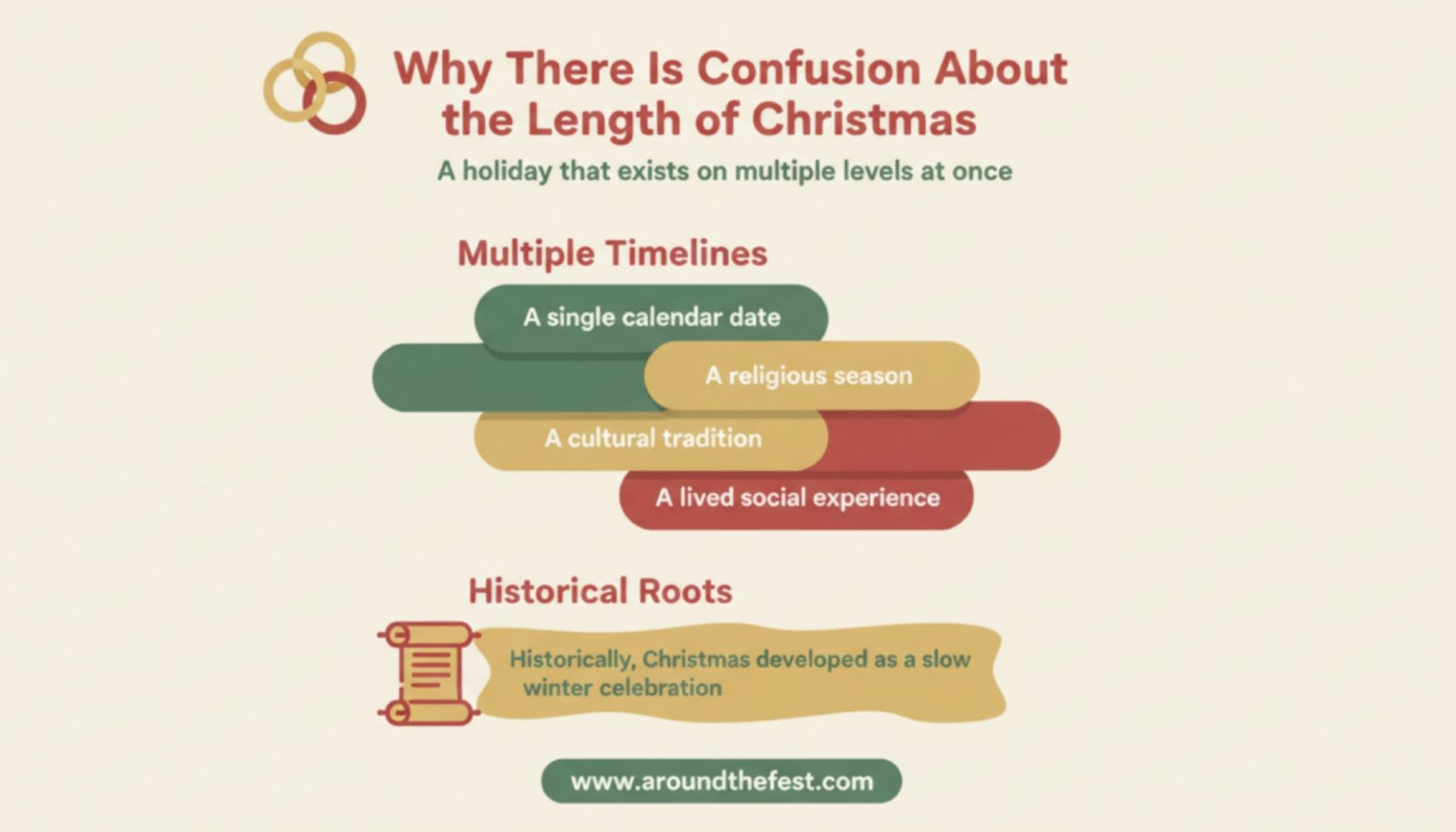
A Holiday That Exists on Multiple Levels at Once
The confusion surrounding how long Christmas lasts begins with the fact that it does not exist on just one level. Christmas functions simultaneously as a date, a religious season, a cultural period, and a social experience. Each of these follows a different timeline, and none of them fully aligns with the others.
When people ask how long Christmas lasts, they are often unknowingly mixing these timelines together. The calendar gives one answer, religious traditions give another, and lived experience offers something entirely different.
Historical Roots of an Extended Celebration
Long before modern calendars, public holidays, or fixed work schedules, Christmas developed as part of a broader cycle of seasonal observances. In agrarian societies, winter marked a natural pause in labor. Celebrations unfolded slowly because daily life itself moved more slowly.
Preparation took weeks. Food preservation, communal gatherings, and religious rituals all required time. The celebration reached its peak on Christmas Day but continued afterward through visits, feasting, and rest. This historical pattern shaped expectations that still exist today, even if people no longer consciously recognize them.
Modern systems shortened official observances, but cultural memory retained the idea of Christmas as a period rather than a moment.
How Human Perception of Time Adds to the Confusion
Psychologically, people do not experience time in equal units. Events that involve anticipation, emotion, and social connection feel longer than ordinary days. It includes all three.
Anticipation stretches the period before the holiday. Emotional intensity slows perception during gatherings. Reflection and memory extend the experience afterward. As a result, Christmas feels longer in the mind than it appears on a calendar.
This explains why people often feel that Christmas “flies by” in one sense but also feels like it lasted weeks when they look back on it.
Religious Calendars Follow Meaning, Not Efficiency
Christian traditions organize time around meaning rather than convenience. Preparation periods, feast days, and concluding observances exist to allow reflection and spiritual understanding to unfold gradually.
These religious structures developed independently of modern work schedules. As a result, they often continue well after public life has returned to normal. For those who follow these traditions, Christmas clearly does not end when offices reopen or schools resume.
This disconnect between sacred time and civic time adds another layer to the confusion.
Cultural Customs Multiply Timelines Further
Culture shapes how families distribute celebration across time. Travel requirements, extended families, and regional customs often mean that gatherings cannot happen all at once.
Some families celebrate before the main holiday. Others gather afterward. Some repeat celebrations multiple times. Each variation extends the sense of Christmas without changing the official date.
When people compare experiences across families or cultures, it becomes difficult to agree on when Christmas truly begins or ends.
Modern Systems Blur Boundaries Even More
Modern life introduces additional complexity. School breaks, end-of-year corporate slowdowns, and overlapping holidays merge Christmas into a larger seasonal pause. Even when Christmas itself lasts one day officially, the surrounding downtime reshapes how it is experienced.
Commercial influence amplifies this effect. Decorations, music, and advertising appear early and linger late, creating a continuous festive environment that resists clear boundaries.
These influences do not create the confusion alone, but they reinforce it.
Global Awareness Removes Any Single Definition
In a globally connected world, people constantly encounter Christmas traditions from other regions. Some cultures observe extended seasons, others focus on specific days. Exposure to these differences removes the idea that one timeline is “correct.”
What once felt clear within a single culture now appears flexible and negotiable.
Why the Confusion Is Inevitable—and Meaningful
The confusion around the length persists because it reflects something deeper: Christmas adapts to human life rather than forcing life to adapt to it. It stretches to accommodate belief, culture, family, and emotion.
Trying to reduce Christmas to a single timeframe ignores what makes it enduring.
Understanding the Overlap Brings Clarity
Clarity does not come from choosing one timeline over another. It comes from recognizing that Christmas operates across overlapping systems of time.
It can be one day on the calendar, several weeks in tradition, and even longer in memory—all at once. Once that overlap is accepted, the question of how long it lasts becomes less about precision and more about perspective.
Frequently Asked Questions About Christmas Timing
1. When is Christmas celebrated every year?
Ans. Christmas is celebrated every year on December 25, regardless of which day of the week it falls on.
2. How many days do people celebrate Christmas?
Ans. Officially, Christmas is one day, but many people celebrate it for several days or even weeks, depending on tradition, culture, and time off.
3. Is Christmas one day or a season?
Ans. On the calendar, Christmas is one day. In practice, many people experience it as a season that includes preparation before and celebrations after December 25.
4. Why does Christmas feel longer than one day?
Ans. Christmas often feels longer because of early preparations, extended family visits, religious observances, school holidays, and time off from work.
5. What are the 12 Days of Christmas and when do they start?
Ans. The 12 Days of Christmas begin on December 25 and end on January 5, marking the period between Christmas Day and Epiphany.
6. When do Christmas celebrations usually end?
Ans. For many people, celebrations end around New Year’s Day or January 6 (Epiphany), depending on culture and tradition.
7. Why do people keep Christmas decorations up after December 25?
Ans. Many traditions keep decorations up to reflect the ongoing festive season, often until early January or Epiphany.
8. Do different countries celebrate Christmas for different lengths of time?
Ans. Yes. Some countries focus mainly on December 25, while others observe extended festive periods that continue into January.
Conclusion-It is More Than a Date, a Shared Experience
It may look simple on the calendar, but in real life, it unfolds across time in ways that reflect belief, culture, history, and everyday routines. For some people, it centers on a single date. For others, it stretches into a season shaped by preparation, shared traditions, and meaningful pauses from normal life.
This layered experience explains why it often feels longer than expected. Religious observances extend beyond one day, cultural customs vary across countries, and school and work schedules create extended periods of celebration. Add family gatherings, travel, and personal traditions, and becomes something far richer than a single holiday.
Understanding this difference between official dates and lived experience removes much of the confusion. it does not follow one universal timeline because it adapts to how people live and celebrate. That flexibility is part of what keeps it relevant across generations and cultures.
Rather than asking how long it should last, it makes more sense to recognize how it naturally fits into different lives. Whether it feels like one meaningful day or a full season of connection, remains a time marked by togetherness, reflection, and shared moments that extend well beyond the calendar.