Bangladesh Independence Day 2026: Date, History and facts
Every year, millions of people celebrate Bangladesh Independence Day, one of the most important national events in the country. Bangladesh Independence Day 2026 will take place on March 26. This historic day marks the declaration of independence in 1971 and the beginning of a new chapter for the nation.
For Bangladeshis, March 26 is more than just a national holiday. It represents courage, sacrifice, and the determination of a people who fought for freedom. The date honors the start of the struggle that eventually created the independent nation of Bangladesh.
Why Bangladesh Independence Day 2026 Is Important
Bangladesh Independence Day remembers the moment when the people of East Pakistan began their fight for independence. Political tensions had been rising for years. Cultural differences and economic inequality created strong demands for autonomy.
The situation reached a turning point in 1971. The independence movement gained momentum under the leadership of Sheikh Mujibur Rahman, a powerful political figure who inspired millions of Bengalis. His speeches and political vision united people across the region and strengthened the movement for freedom.
Soon after the declaration of independence, a nine-month conflict began. This conflict became known as the Bangladesh Liberation War of 1971. During this war, freedom fighters and ordinary citizens resisted military forces and struggled for their nation’s independence.
Remembering the Heroes of the Liberation War
The liberation war demanded enormous sacrifice. Millions of people suffered during the conflict, and many lost their lives while defending their homeland. The bravery of these individuals continues to inspire the nation today.
One of the most important memorials honoring these sacrifices is the National Martyrs’ Memorial. Located near Dhaka, this monument stands as a symbol of respect for those who gave their lives for independence.
Every year on March 26, citizens gather at memorials, schools, and public spaces across the country to remember the heroes of the liberation struggle.
What This Guide Will Cover
Understanding Bangladesh Independence Day 2026 helps us understand the nation’s identity and history. This guide explains the full story behind the national holiday.
In this article, you will learn:
- The exact date of Bangladesh Independence Day 2026
- The historical events that led to independence
- The 1971 Liberation War and its major milestones
- The leaders and heroes of the independence movement
- Important facts and traditions related to the national holiday
Together, these sections will give you a complete picture of why Bangladesh Independence Day remains one of the most meaningful days in the country’s history.
When Is Bangladesh Independence Day 2026?
Bangladesh Independence Day in 2026 will be celebrated on March 26, 2026. This date marks the anniversary of Bangladesh’s declaration of independence in 1971. Every year, people across the country observe this day with pride, remembrance, and national celebrations.
March 26 is a national public holiday in Bangladesh. Government offices, schools, and many businesses remain closed so citizens can participate in ceremonies and events that honor the nation’s freedom. From the capital city of Dhaka to small towns and villages, communities organize programs that reflect the spirit of independence.
Why March 26 Is the Independence Day of Bangladesh
The date of March 26 holds deep historical importance. On the night of March 25, 1971, the political crisis between East Pakistan and the Pakistani government reached a breaking point. Military forces launched a violent operation in Dhaka and other cities. This operation aimed to suppress the growing movement for autonomy and political rights.
In response, the leaders of the Bengali independence movement declared the independence of Bangladesh. The declaration signaled the beginning of a nationwide resistance movement. Soon after, people across the region joined the fight for freedom.
The independence declaration followed the political leadership of Sheikh Mujibur Rahman, who had long advocated for the rights of the Bengali population. His historic speech on March 7, 1971 inspired millions of people and prepared the nation for the struggle ahead.
The events of March 25 and 26 marked the start of the Bangladesh Liberation War of 1971, a nine-month conflict that eventually led to the creation of Bangladesh as an independent country.
National Recognition of the Day
After Bangladesh gained independence in December 1971, March 26 became officially recognized as the country’s Independence Day. Since then, the government and citizens have observed this date every year as a symbol of freedom and national unity.
The celebrations usually begin early in the morning with the hoisting of the national flag. Public institutions, schools, and private organizations organize cultural programs, parades, and discussions about the country’s history.
One of the most significant ceremonies takes place at the National Martyrs’ Memorial, located near Dhaka. Government leaders, military officials, and citizens place wreaths at the monument to honor those who sacrificed their lives during the liberation struggle.
Independence Day vs. Victory Day
Many people sometimes confuse Bangladesh Independence Day with another national holiday called Victory Day (Bangladesh). Although both dates relate to the country’s independence, they commemorate different events.
- Independence Day (March 26) marks the declaration of independence and the beginning of the liberation war.
- Victory Day (December 16) celebrates the final victory in 1971 when Pakistani forces surrendered and Bangladesh officially emerged as an independent nation.
Together, these two days tell the complete story of Bangladesh’s struggle for freedom.
Importance of the Date in Modern Bangladesh
Today, March 26 serves as a reminder of the sacrifices made by millions of people during the independence movement. It also represents the resilience and unity of the Bangladeshi people.
Educational institutions organize history lessons, essay competitions, and cultural programs to teach younger generations about the significance of this day. Television channels, newspapers, and online platforms publish special features that highlight the events of 1971 and the heroes of the liberation war.
For Bangladeshis living abroad, Independence Day also provides an opportunity to celebrate their heritage and connect with their cultural roots.
Historical Background of Bangladesh Independence
To understand the significance of Bangladesh Independence Day 2026, it is important to explore the historical events that led to the creation of the country. Bangladesh did not become independent overnight. The journey toward freedom developed over decades of political struggles, cultural movements, and demands for equal rights.
Several key events shaped the path that eventually led to independence in 1971.
The Partition of India in 1947
The roots of Bangladesh’s independence trace back to the Partition of India in 1947. When British colonial rule ended in South Asia, the region divided into two independent countries: India and Pakistan.
Pakistan itself consisted of two geographically separate regions:
- West Pakistan (present-day Pakistan)
- East Pakistan, which later became Bangladesh
These two regions lay more than 1,600 kilometers apart, with India located between them. Although both areas shared the same national identity as Pakistan, they differed greatly in language, culture, and economic conditions.
Most people in East Pakistan spoke Bengali, while the government of Pakistan promoted Urdu as the national language. This decision created strong resentment among the Bengali population and triggered one of the earliest movements for cultural rights.
The Bengali Language Movement of 1952
One of the most important turning points in the history of Bangladesh occurred during the Bengali Language Movement of 1952.
The Pakistani government announced that Urdu would become the only official language of the country. However, the majority of people in East Pakistan spoke Bengali. Students, intellectuals, and political activists strongly opposed the decision.
On February 21, 1952, students in Dhaka organized protests demanding recognition of Bengali as a state language. Police opened fire on demonstrators, and several students lost their lives.
The tragedy shocked the entire region and strengthened the Bengali identity movement. Eventually, the government recognized Bengali as one of the official languages of Pakistan.
Today, February 21 is internationally recognized as International Mother Language Day, honoring the sacrifices made during the language movement.
Economic and Political Inequality
Throughout the 1950s and 1960s, tensions between East Pakistan and West Pakistan continued to grow. Many people in East Pakistan believed the central government ignored their economic and political interests.
Despite having a larger population, East Pakistan received fewer resources and less political representation. Development projects and major government investments mainly benefited West Pakistan.
These inequalities caused frustration among the Bengali population. Political leaders and activists began demanding greater autonomy for East Pakistan.
During this time, Sheikh Mujibur Rahman emerged as a powerful voice for the rights of Bengalis. His political vision focused on self-governance, democracy, and economic equality.
The Six-Point Movement of 1966
In 1966, Sheikh Mujibur Rahman introduced a historic political program known as the Six-Point Movement. This plan outlined six major demands that aimed to give East Pakistan greater autonomy within Pakistan.
The six points included proposals for:
- A federal government structure
- Separate currencies or financial systems
- Greater control over taxation and revenue
- Regional control over economic policies
- Separate military forces for East Pakistan
Many people in East Pakistan supported these demands because they believed the plan would protect their political and economic rights.
However, the Pakistani government viewed the movement as a threat to national unity. Authorities arrested Sheikh Mujibur Rahman and several other political leaders. Instead of weakening the movement, these arrests increased public support for autonomy.
The 1970 General Election Crisis
Another major turning point came during the 1970 Pakistani General Election. This election was the first democratic national election held in Pakistan.
The political party led by Sheikh Mujibur Rahman, the Awami League, won a huge victory. The party secured the majority of seats in the national assembly, largely due to overwhelming support from East Pakistan.
According to democratic rules, Sheikh Mujibur Rahman should have become the leader of Pakistan’s national government. However, political leaders in West Pakistan refused to transfer power.
This political deadlock created massive protests and civil unrest across East Pakistan. The population demanded that the election results be respected.
The crisis escalated rapidly and pushed the region closer to a major conflict.
Rising Tensions Before Independence
By early 1971, the political situation had become extremely tense. Protests, strikes, and mass gatherings took place across East Pakistan. Millions of people demanded political rights and autonomy.
On March 7, 1971, Sheikh Mujibur Rahman delivered a historic speech in Dhaka that inspired the entire nation. In this speech, he called on the people to prepare for a struggle for freedom.
Just a few weeks later, the situation exploded into violence. On the night of March 25, 1971, Pakistani military forces launched a brutal crackdown in Dhaka.
This event triggered the declaration of independence and the beginning of the Bangladesh Liberation War of 1971.
The Declaration of Independence on March 26, 1971
The most critical moment in the history of Bangladesh Independence Day 2026 occurred on the night of March 25, 1971, and the early hours of March 26, 1971. This period marked the transition from political struggle to active armed conflict and the formal assertion of Bangladesh’s independence.
Operation Searchlight: The Spark
On March 25, 1971, the Pakistani military launched a massive operation called Operation Searchlight. The aim was to suppress growing demands for autonomy in East Pakistan. Dhaka, the capital, became the primary target. Military forces attacked universities, government buildings, and residential areas. Civilians, students, and political leaders faced brutal violence. Thousands were killed in the initial hours of the operation.
The intensity of the crackdown shocked the population. It became clear that East Pakistan’s political and cultural rights could not be achieved within the framework of Pakistan. This event forced Bengali leaders to take decisive action toward full independence.
Sheikh Mujibur Rahman’s Role
Before his arrest by Pakistani forces, Sheikh Mujibur Rahman had already set the foundation for independence through political mobilization. Though he was detained in West Pakistan during the crackdown, his earlier speeches, especially the historic March 7 speech, inspired millions of people to resist oppression. His leadership became the symbol of the Bengali struggle for freedom.
The First Declaration
In response to the military action, local political and military leaders in East Pakistan took swift measures. They formally declared the independence of Bangladesh in several locations, sending messages through radio broadcasts and underground networks. The declaration emphasized:
- The right of the Bengali people to self-rule
- The end of Pakistani military domination in East Pakistan
- The beginning of a nationwide struggle for freedom
The first broadcast announcing independence was made by M. A. Hannan and Ziaur Rahman, officers in the East Pakistan military, on the radio station in Chittagong, which became a symbol of resistance for the nation.
Beginning of the Liberation War
The declaration on March 26, 1971, is widely regarded as the official start of the Bangladesh Liberation War. Across East Pakistan, people organized protests, strikes, and armed resistance. Ordinary citizens joined the fight alongside members of the Mukti Bahini, the organized liberation army that would later conduct guerrilla warfare against Pakistani forces.
From March 26 onwards, the struggle for independence transformed into a full-scale war that would last nine months. Despite facing a well-equipped military, the Bengali people’s determination and resilience became the cornerstone of the liberation effort.
Significance of March 26
March 26 is not just a date; it represents the birth of a nation. It signifies:
- Courage in the face of oppression
- Unity of the Bengali population
- The start of a movement that would ultimately achieve independence
- Sacrifice of countless freedom fighters and civilians
By declaring independence, the leaders and citizens of East Pakistan sent a clear message to the world: they would no longer accept political and cultural subjugation.
The Bangladesh Liberation War of 1971
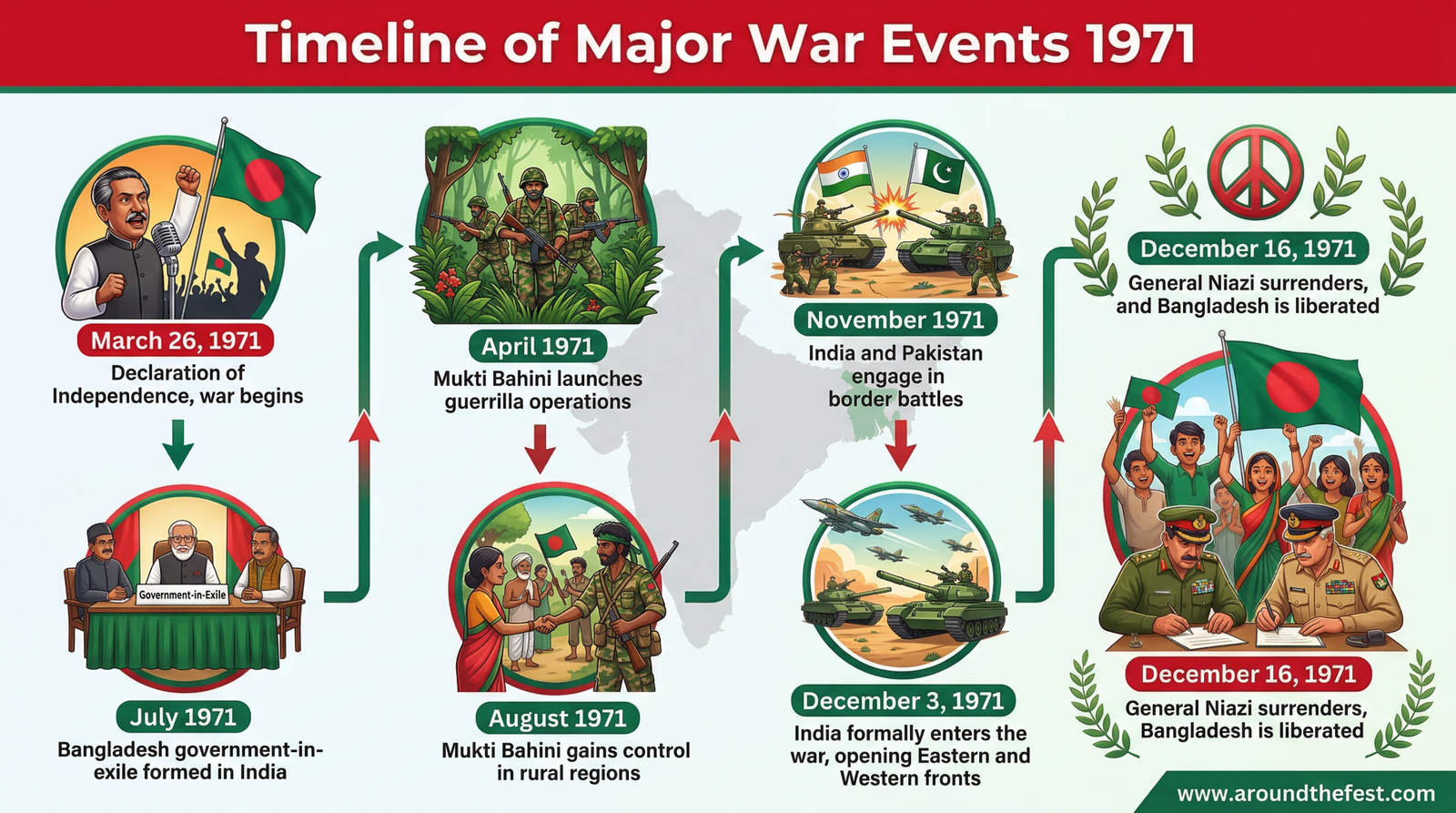
The Bangladesh Liberation War lasted from March 26 to December 16, 1971. It was a nine-month struggle that led to the birth of an independent Bangladesh. The war involved massive coordination between ordinary citizens, organized resistance groups, and political leaders. It also drew international attention and support.
Formation of the Mukti Bahini
After the crackdown on March 25, 1971, ordinary citizens and military defectors formed the Mukti Bahini (Liberation Army). This guerrilla force became the backbone of the independence struggle.
Key details:
- Composed of Bengali soldiers, police officers, students, and volunteers.
- Operated in rural areas, forests, and border regions to carry out guerrilla attacks.
- Focused on sabotaging infrastructure and disrupting Pakistani military operations.
- Trained in secret camps, often with support from local communities and sympathetic political leaders.
The Mukti Bahini symbolized the determination of ordinary citizens to fight for independence, even under extreme danger.
Key Battles and Guerrilla Warfare
While the Mukti Bahini primarily relied on guerrilla tactics, several major battles defined the war:
1. Battle of Kalurghat (March 1971)
- Location: Chittagong
- Early resistance against Pakistani forces; secured radio station to broadcast independence messages.
2.Sector-Based Guerrilla Operations
- The country was divided into 11 sectors, each led by a commander.
- Sectors coordinated attacks on military installations, supply routes, and communication lines.
3.Battle of Garibpur (November 1971)
- Fought near the India-East Pakistan border.
- Pakistani forces clashed with Mukti Bahini and Indian troops supporting them.
The guerrilla operations created constant pressure on Pakistani forces, slowing their advance and gaining international attention.
Role of India and International Support
India played a crucial role in the war. After millions of refugees crossed into India due to Pakistani military atrocities, India provided:
- Training camps for Mukti Bahini fighters
- Weapons, ammunition, and logistical support
- Strategic guidance for coordinated attacks
On December 3, 1971, Pakistan launched airstrikes on India, triggering the India-Pakistan War of 1971. India officially intervened to support Bangladesh’s independence movement.
Internationally, the conflict drew global attention. Media coverage highlighted:
- Human rights violations
- Refugee crisis
- Civilian massacres
This coverage helped generate diplomatic pressure on Pakistan and increased support for the independence movement.
Humanitarian Crisis
The war caused a massive humanitarian crisis:
- Around 10 million refugees fled to India.
- Three million people were killed, including civilians and freedom fighters.
- Thousands of women and children suffered atrocities and displacement.
- Major cities, villages, and infrastructure were severely damaged.
Despite these hardships, the people of East Pakistan continued to resist. Communities supported the Mukti Bahini with food, shelter, and information.
Victory and the Birth of Bangladesh
On December 16, 1971, Pakistani forces surrendered to the allied Mukti Bahini and Indian troops. This day is now celebrated as Victory Day, marking the official birth of Bangladesh as a sovereign nation.
The Liberation War not only secured political independence but also established a national identity rooted in language, culture, and self-determination.
Legacy of the Liberation War
The war left a lasting impact:
- Strengthened national unity and cultural pride
- Inspired generations of leaders, activists, and citizens
- Established memorials, museums, and educational programs to honor freedom fighters
- Continues to be a central theme in Bangladesh’s Independence Day celebrations
How Bangladesh Celebrates Independence Day
Every year on March 26, citizens across Bangladesh celebrate Bangladesh Independence Day 2026 with deep pride and remembrance. The day honors the courage and sacrifice of those who fought during the Bangladesh Liberation War of 1971. It is both a national celebration and a solemn moment to remember the heroes who helped build the nation.
From the capital city of Dhaka to the smallest rural villages, people participate in ceremonies, cultural events, and patriotic activities that reflect the country’s unity and history.
Early Morning Ceremonies and Flag Hoisting
The celebrations begin early in the morning with the hoisting of the national flag. Government buildings, schools, universities, and private organizations raise the green and red flag of Bangladesh as a symbol of freedom and national pride.
The day often begins with:
- National flag hoisting at government offices
- Singing of the national anthem
- Special prayers for the country and its people
- Gun salutes by the military
At important public venues, officials and citizens gather to pay tribute to the nation’s founding heroes.
One of the most significant locations for these ceremonies is the National Martyrs’ Memorial near Dhaka. Political leaders, military officers, diplomats, and thousands of citizens place wreaths at the monument to honor those who sacrificed their lives during the liberation struggle.
Military Parades and Official State Ceremonies
Independence Day also includes grand military parades and official state events. These ceremonies highlight the strength and unity of the nation.
The Bangladesh Armed Forces organize impressive parades that include:
- Army, navy, and air force units
- Marching bands and ceremonial guards
- Military aircraft flyovers
- Displays of national defense capabilities
Senior government officials, including the president and prime minister, attend these ceremonies. They deliver speeches that honor the freedom fighters and remind citizens of the values that shaped the nation.
These events also serve as a reminder of the sacrifices made by the people who fought for independence in 1971.
Cultural Programs and Patriotic Performances
Cultural celebrations form a major part of Independence Day. Schools, universities, and community organizations host programs that showcase the rich cultural heritage of Bangladesh.
These programs often include:
- Traditional music and patriotic songs
- Dance performances based on historical themes
- Poetry recitations honoring freedom fighters
- Theater productions depicting events from the liberation war
Famous patriotic songs written during the independence movement are widely performed. These songs remind people of the courage and resilience of the nation during the liberation struggle.
Educational institutions also organize competitions such as:
- Essay writing contests
- Art and painting competitions
- Historical storytelling events
These activities help younger generations learn about the country’s history and national identity.
Visiting Memorials and Historical Sites
Many citizens spend part of Independence Day visiting important memorials and historical locations. These sites honor the heroes who gave their lives for freedom.
Some of the most important places people visit include:
- National Martyrs’ Memorial – a tribute to the freedom fighters
- Liberation war museums and historical exhibits
- Memorials dedicated to student leaders and activists
Families often bring flowers and candles to these memorials. Schools organize educational trips so students can learn more about the sacrifices made during the independence movement.
Media, Television, and Special Broadcasts
Television channels, newspapers, and digital media platforms play a major role in Independence Day celebrations. On March 26, most media outlets produce special programming dedicated to the history of the country.
These broadcasts typically include:
- Documentaries about the 1971 liberation war
- Interviews with freedom fighters and historians
- Historical films about the independence movement
- Patriotic music concerts and cultural shows
News organizations also publish special articles that highlight the stories of ordinary citizens who contributed to the independence struggle.
These media programs help keep the memory of the liberation war alive for future generations.
Celebrations Among the Bangladeshi Diaspora
Independence Day is not only celebrated inside Bangladesh. Bangladeshi communities around the world also organize events to honor the nation’s history.
Large celebrations often take place in countries such as:
- United Kingdom
- United States
- Canada
- Australia
These events include:
- Cultural festivals
- Community gatherings
- Traditional food celebrations
- Historical discussions and exhibitions
Such events allow overseas Bangladeshis to celebrate their heritage while sharing their culture with the wider world.
Symbolism and National Pride
The colors of the Bangladeshi flag play an important role during Independence Day celebrations.
- Green represents the natural beauty and fertile land of Bangladesh.
- Red symbolizes the sacrifices and bloodshed during the liberation struggle.
Buildings, streets, and public spaces are decorated with flags and national colors. Schools and institutions organize patriotic displays to show respect for the country’s history.
Why Independence Day Still Matters Today
Independence Day continues to hold great importance for the people of Bangladesh. It reminds citizens of the struggles their ancestors faced and the sacrifices that made the country’s independence possible.
The day also encourages reflection on the values that shaped the nation:
- Freedom
- Democracy
- Cultural identity
- National unity
By celebrating Independence Day every year, Bangladesh keeps the memory of the liberation movement alive and inspires future generations to protect the country’s independence and progress.
20 Interesting Facts About Bangladesh Independence Day 2026
Bangladesh Independence Day 20226 is not only a historic national celebration but also a day filled with powerful stories, cultural symbolism, and remarkable historical milestones. While many people know that the day marks the declaration of independence on March 26, 1971, there are many fascinating facts behind the event and the struggle that created Bangladesh.
Here are some important and interesting facts that highlight the significance of Bangladesh’s Independence Day.
1. Bangladesh Was Once Part of Pakistan
Before independence, Bangladesh was known as East Pakistan. After the Partition of India in 1947, Pakistan consisted of two separate regions: West Pakistan and East Pakistan. These regions were more than 1,600 kilometers apart and had different languages, cultures, and economic systems.
2. Language Played a Major Role in Independence
The demand to recognize the Bengali language sparked one of the earliest protests against Pakistani rule. The Bengali Language Movement of 1952 became a powerful symbol of cultural identity and resistance. The movement later inspired the broader struggle for political independence.
3. Sheikh Mujibur Rahman Is Known as the “Father of the Nation”
The independence movement was led by Sheikh Mujibur Rahman, who is widely regarded as the founding leader of Bangladesh. His leadership and historic speeches inspired millions of people to join the struggle for freedom.
4. The Liberation War Lasted Nine Months
The Bangladesh Liberation War lasted from March 26 to December 16, 1971. During these nine months, freedom fighters and civilians resisted Pakistani military forces until Bangladesh achieved victory.
5. Millions of People Took Part in the Resistance
The war involved not only trained soldiers but also students, farmers, workers, and ordinary citizens. Many people joined the Mukti Bahini, the guerrilla force that played a crucial role in fighting against Pakistani troops.
6. A Massive Refugee Crisis Occurred During the War
During the conflict, approximately 10 million refugees fled to India to escape violence and military operations. This humanitarian crisis attracted international attention and increased global awareness of the situation.
7. The War Ended With Victory on December 16, 1971
Bangladesh achieved complete independence when Pakistani forces surrendered on December 16, 1971. This day is now celebrated as Victory Day (Bangladesh).
8. The National Flag Symbolizes Sacrifice and Hope
The green background of the Bangladeshi flag represents the country’s natural beauty, while the red circle symbolizes the blood sacrificed by freedom fighters during the liberation war.
9. The National Martyrs’ Memorial Honors War Heroes
The National Martyrs’ Memorial near Dhaka stands as a tribute to those who died during the independence struggle. Every year on March 26, thousands of people visit the monument to pay their respects.
10. March 26 Is a National Public Holiday
On Independence Day, government offices, schools, and many businesses remain closed across Bangladesh so people can participate in national ceremonies and commemorative events.
11. Schools Play a Big Role in Celebrations
Educational institutions organize cultural programs, essay competitions, and historical exhibitions to teach students about the country’s independence movement.
12. Independence Day Celebrations Begin Early in the Morning
The day typically begins with the hoisting of the national flag and gun salutes by the Bangladesh Armed Forces.
13. Patriotic Songs Are an Important Part of the Day
Songs written during the liberation war are performed throughout the country. These songs celebrate courage, unity, and the sacrifices made during the independence struggle.
14. Bangladesh’s Independence Movement Inspired Global Support
International media coverage of the conflict helped raise awareness about human rights issues and the humanitarian crisis during the war.
15. The Independence Movement Strengthened National Identity
The struggle for independence united the Bengali people and strengthened their cultural identity, language, and traditions.
16. The Independence Speech of March 7 Is Historic
Sheikh Mujibur Rahman’s speech on March 7, 1971 inspired millions of people and prepared the nation for the fight for independence. The speech remains one of the most powerful political speeches in history.
17. Women Played a Crucial Role in the War
Women participated in the resistance by helping fighters, providing medical aid, and supporting communities affected by the war.
18. Bangladesh Celebrates Independence Worldwide
Bangladeshi communities living abroad celebrate the day in countries such as the United States, United Kingdom, and Canada with cultural programs and community gatherings.
19. Independence Day Inspires Artistic Expression
Artists, poets, filmmakers, and writers often create works that explore themes of freedom, resilience, and national pride.
20. The Day Represents Hope for the Future
More than just a historical anniversary, Independence Day reminds citizens of the importance of freedom, unity, and national progress.
Role of International Politics and Global Reactions During the Liberation War
The struggle that led to Bangladesh Independence Day did not occur in isolation. The Bangladesh Liberation War became a major international issue that attracted attention from governments, journalists, humanitarian organizations, and global political powers.
The war created a humanitarian crisis that forced the international community to react in different ways.
The Refugee Crisis and Global Awareness
One of the most significant consequences of the war was the massive refugee crisis. Millions of civilians fled violence and crossed the border into India.
Historians estimate that:
- Around 10 million refugees sought shelter in India
- Thousands of villages were destroyed
- Millions of civilians were displaced
This crisis attracted worldwide media coverage and raised global awareness about the conflict.
International journalists and human rights activists reported on the violence and humanitarian challenges faced by civilians.
India’s Strategic Role
India played the most direct international role in the liberation struggle. The government of India provided support to the resistance movement in several ways:
- Training camps for freedom fighters
- Military and logistical assistance
- Refugee support programs
- Diplomatic pressure on Pakistan
In December 1971, the conflict escalated when Pakistan launched air attacks on Indian military bases. This triggered the Indo-Pakistani War of 1971, which ultimately led to Pakistan’s surrender.
Global Political Reactions
During the Cold War era, global powers reacted differently to the crisis.
Some countries supported Pakistan for strategic reasons, while others sympathized with the Bengali independence movement.
The war sparked debates in international politics about:
- Human rights
- National self-determination
- The responsibilities of global powers during humanitarian crises
International pressure eventually increased as evidence of violence and refugee displacement became widely reported.
Media Coverage and Public Opinion
International media played a major role in shaping global public opinion. Journalists documented the humanitarian crisis and the experiences of civilians affected by the conflict.
Reports published in international newspapers and television broadcasts helped raise awareness about the situation in Bangladesh.
Public demonstrations and humanitarian campaigns also took place in several countries, calling for international action.
International Recognition of Bangladesh
After the surrender of Pakistani forces on December 16, 1971, many countries quickly recognized Bangladesh as an independent nation.
Diplomatic recognition allowed Bangladesh to join the global community and begin building international relationships.
This recognition marked the final stage of the independence struggle that began on March 26, 1971.
10 Powerful Quotes from Sheikh Mujibur Rahman
The struggle that led to Bangladesh Independence Day 2026 was inspired by the powerful leadership and vision of Sheikh Mujibur Rahman. Often called the “Father of the Nation”, he played a central role in mobilizing millions of Bengalis to demand political rights, dignity, and freedom.
His speeches and messages during the independence movement became symbols of hope and resistance. Many of his words are still quoted today during national celebrations and historical commemorations in Bangladesh.
Below are ten powerful quotes attributed to Sheikh Mujibur Rahman that reflect the spirit of the liberation movement.
1. “The struggle this time is the struggle for our freedom; the struggle this time is the struggle for our independence.”
This famous line from Sheikh Mujibur Rahman’s historic March 7, 1971 speech inspired millions of people across the country. The words became a rallying call for the independence movement and symbolized the determination of the Bengali people.
2. “Build forts in each home. Face the enemy with whatever you have.”
In this statement, Mujibur Rahman urged ordinary citizens to prepare for resistance and defend their rights. The message encouraged unity and courage during a time of uncertainty.
3. “No one can suppress the voice of the people.”
This quote highlights the belief that the collective will of the people is stronger than oppression. It reflects the democratic spirit that shaped the independence movement.
4. “Bangladesh must stand on its own feet.”
Mujibur Rahman emphasized self-reliance and national pride. His vision focused on building a country that could govern itself and determine its own future.
5. “We may die, but our people will live free.”
This statement captured the willingness of the independence movement to sacrifice everything for freedom.
6. “Our struggle is for justice and equality.”
During the political movement leading to independence, Mujibur Rahman frequently highlighted the need for fairness, economic equality, and political representation.
7. “The history of our struggle is the history of the people.”
This quote emphasizes that the independence movement was not just led by political figures but by millions of ordinary citizens.
8. “Freedom is the birthright of every nation.”
Mujibur Rahman believed that every nation had the right to determine its own destiny. This belief guided the independence movement.
9. “The Bengali nation will rise again.”
These words reflected optimism and resilience during the difficult years of political repression and conflict.
10. “We want peace, but we are ready to fight for our rights.”
This quote captured the core philosophy of the independence movement: the desire for peace, combined with the determination to resist injustice.
Why These Quotes Still Matter Today
The words of Sheikh Mujibur Rahman continue to inspire people across Bangladesh and beyond. His speeches remind citizens of the courage and unity that shaped the country’s history.
During celebrations of Bangladesh Independence Day 2026, these quotes are often recited in schools, cultural programs, and public ceremonies. They serve as powerful reminders of the ideals that guided the independence movement.
Frequently Asked Questions About Bangladesh Independence Day 2026
Q1. When is Bangladesh Independence Day 2026?
Ans. Bangladesh Independence Day in 2026 will be observed on March 26, 2026. The day commemorates the declaration of independence in 1971 and marks the beginning of the liberation struggle that created Bangladesh.
Q2. Why is Bangladesh Independence Day celebrated on March 26?
Ans. Bangladesh celebrates Independence Day on March 26 because the country declared independence from Pakistan on this date in 1971. The declaration followed a military crackdown and led to the start of the Bangladesh Liberation War.
Q3. Who declared the independence of Bangladesh?
The independence movement was led by Sheikh Mujibur Rahman, who is widely known as the Father of the Nation. His leadership and historic speeches inspired the Bengali people to fight for freedom.
Q4. What happened on March 26, 1971?
On March 26, 1971, leaders of the Bengali independence movement declared Bangladesh an independent nation after the Pakistani military launched Operation Searchlight in Dhaka. This event marked the start of the liberation war.
Q5. How long did the Bangladesh Liberation War last?
The Bangladesh Liberation War lasted about nine months, from March 26 to December 16, 1971. The war ended when Pakistani forces surrendered and Bangladesh became an independent country.
Q6. How is Bangladesh Independence Day celebrated?
People celebrate the day with:
- national flag hoisting
- military parades
- cultural programs and patriotic songs
- visits to memorials honoring freedom fighters
Major ceremonies take place at the National Martyrs’ Memorial.
Q7. What is the difference between Bangladesh Independence Day and Victory Day?
Ans, Bangladesh Independence Day (March 26) marks the declaration of independence and the start of the liberation war.
Victory Day (Bangladesh) (December 16) celebrates the final victory and surrender of Pakistani forces in 1971.
Q8. Why is the Bangladesh Liberation War important?
Ans. The Bangladesh Liberation War was the struggle that led to the creation of Bangladesh as an independent nation. It represents the courage, sacrifice, and determination of millions of people who fought for freedom and national identity.
Q9. Is Bangladesh Independence Day a public holiday?
Ans. Yes, Bangladesh Independence Day 2026 is a national public holiday in Bangladesh. Government offices, schools, and many businesses remain closed while citizens participate in national celebrations.
Q10. Why is Sheikh Mujibur Rahman important in Bangladesh history?
Ans. Sheikh Mujibur Rahman played a central role in the independence movement. His leadership, speeches, and political vision united the Bengali population and helped lead the country toward independence.
Conclusion: Why Bangladesh Independence Day Still Matters Today
Bangladesh Independence Day 2026 is more than just a national holiday. It marks the birth of a nation and honors the courage, sacrifices, and determination of millions of people who fought for freedom in Bangladesh.
On March 26, citizens remember the historic declaration that led to the Bangladesh Liberation War, a nine-month struggle that ultimately created an independent nation. The leadership of Sheikh Mujibur Rahman and the bravery of the Mukti Bahini freedom fighters played a crucial role in shaping the country’s destiny.
Today, the day is celebrated with patriotic pride across the nation. People hoist the national flag, attend ceremonies, and pay tribute to the martyrs at places like the National Martyrs’ Memorial. Schools, cultural organizations, and communities also organize events to educate younger generations about the importance of freedom and national identity.
Beyond Bangladesh, this historic day stands as a powerful reminder of the universal struggle for independence, dignity, and self-determination. It highlights how unity, courage, and determination can change the course of history.
As you explore global history and cultural celebrations, Bangladesh Independence Day 2026 remains one of the most significant national days in the world — a symbol of resilience, sacrifice, and hope for future generations.